| . |
Do you find this site helpful?
HOME CONTACT US
Fruit Flies
melanogaster
hydei
More about:
grindal worms
micro worms
mini micros
vinegar eels
harvesting
eels
daphnia pulex
daphnia magna
moina
duckweed
white worms
springtails
waxworms
mealworms
redworms
superworms
flour beetles
rotifers
freshwater
salt water
baby cocktails
baby brine shrimp
Microcultures
greenwater
infusoria
paramecium
Fortifying the Food
Why Live Foods
What Fish Eat...
About The Bug Farm
What Others say...
The Bug Farm
San Rafael, CA 94903 USA
© 2001, 2002, 2003, 2005, 2007, 2009,
J.Atchison |
 Use these for:
· Betta from 1/2
inch to adult
· Corydoras from 1/2 inch through adults
· Newts
· Salamanders
· Some Frogs
· Apistogramma 1/2 inch through adult
· Killifish from 1/2 inch through adult
· Gourami from 1/2 inch through adult
· Guppy 1/2 inch through adult
Angelfish from 1/4 inch to 1/2 inch...and discus too.
· Ask us
more about Grindal worms
A friend taught us how to grow these
miniature worms. The method he showed us was so easy and nearly fool proof. There are more
complicated techniques but this method worked for us for a long time. We only switched
from the technique when the number of fish in the hatchery required us to grow larger
numbers of worms.
We started growing the Grindal worms when
we got into Killifish. We found that the smaller adult fish did great on them and because
most of the fish we were working with at the time were small, we used these worm on nearly
all of our fish that were greater than 1/4 inches long. This first culture method yielded
some peat moss as a by-product and this small amount of peat moss was simply added to the
tanks with the fish. With several fish, the peat moss with actually have an added value as
a pH suppressor. As our species within the hatchery grew, the peat moss became a small
liability and we switched our harvesting methods.
There seems to be a need to
transition fish from one food size to another, particularly from baby brine shrimp and
microworms into the sizes of say, whiteworms. As our fish interests grew, we started
working with greater number of species and types of fishes and noticed that universally
the fry would take the Grindal worms when the fry grew to about 1/4 inch. It didn't matter
what kind of fry, they all loved the Grindals. With the Grindals, the fry get more into
their mouths in a shorter period of time...spending less energy for more food value. What
a deal.
For a few tanks of Killifish or for a tank
or two of fry, a small butter/margarine tub will be large enough to feed all of your fish
every other day. If you think about it for a bit, that means that with two culture you
will have a near continuos supply of Grindals. Our smaller Grindal worm culturing system,
you should be able to feed a tank or two of fry or the few tanks in a smaller fishroom.
The medium culture system should be able to yield upwards of a teaspoon of worms every
other or every third day.
We use about two inches of damp coconut fiber or peat moss as bedding for the worms. Any
less and the culture has a tendency to dry out too quickly. If more than a couple of
inches are added to the container will have to be fairly deep and the bottom of the peat
might become become anaerobic...not a good thing for worms.
Any medium you chose will have to be wetted
to start with. Wetting peat moss is a little tricky. We like to use a large pot on the
stove top, adding enough peat to fill the container to about 1/2 of it's volume and then
adding enough hot water to bring the top of the peat moss up to the top of the container.
We put the heat on to about 1/2 or the capacity of the stove, set a timer for about an
hour and watch some TV. When the buzzer goes off, we turn off the stove and let the peat
moss steam in the pot as it cools to the room temperature.
If you have chosen to use straight peat
moss and notice that the worms do not seem to be moving through the peat or that they tend
to crawl up the sides of the container, it is usually because the peat is too acidic. If
that is the case, mix the peat with plain potting soil in a 50/50 ratio. You can also add
a well rounded tablespoon of garden lime to two gallons of peat moss to bring the acidity
of the soil a little more close to neutral pH.
The moisture is squeezed from the medium
leaving it damp, not sloppy wet but definitely not on the dry side. To this medium, we add
a starter of Grindal worms and then a little food.
We have started using plastic containers
such as shoe boxes and sweater boxes for culturing the worms. The sweater boxes are about
twice the size of a shoe box. We like to use plastic because we can clean the boxes
between culturing and can poke air holes through the plastic with simple tools. The air
holes are very important, especially in warmer weather. A good culture grows very quickly
and with all worms, a moist, aerated culture is important. A lack of air is also a common
reason for worms trying to leave the culture medium, crawling up the sides and dying.

When we start a new culture we add some food. Simply sprinkling it on top of the new
culture. While we have found that Gerber's baby cereal works well, we have found that a
multi-grained food to be a little better. You can come up with your own mix with a little
experimentation or use our special Grindal Worm Food. We sprinkle a little cereal (a light
dusting) onto the surface of the peat and add a few drops of water. The worms don't like
to eat dry food and repeatedly adding cereal without water will dry out the culture. If
you keep your culture in a cool and dark place you will not need to cover the peat moss.
Of course, the container is covered so moisture is kept inside the container. Remember,
these worms like a cool and damp environment. Seventy to seventy-two degrees Fahrenheit is
great. When the outside temperature gets hot we keep our cultures on the floor of the
hatchery. Most of the time the floor is a perfect temperature. Unlike whiteworms
which will start to die as the temperature heads towards 80 F, Grindal worms will do well
in the mid-80 range and in the mid-90s simply stop reproducing but will bounce back as
soon as the temperature drops again.
In extremely hot weather (in the upper 90s
and low 100s F) you might try placing the culture in a old fish shipping styrofoam box
with a bottle of frozen water. By rotating the bottle with a fresh frozen one each
morning, you can keep the temperature inside the insulated and covered box cool enough for
the worms even in the hottest of days. If you live in an area that routinely sees
temperatures in the low 100s, you might find that you need to change the water bottles
twice a day, but the process is simple and cheap.
As the worms finish up their food they hang around the area where the food was and are
ready for harvest. We feed an amount of food that the worms will eat in a single day. Too
much food and the food starts to mold before the worms get to it. Too little food and the
worms can't grow and duplicate. You will quickly develop an "eye" for how much
food to feed, but aim for the amount that they will finish off in a single day. There are
times when we want to feed a tank of fish and just drop a wad of worms directly from the
tub into the tank.Since we raise so many killifish and the Bettas we raise are species
types, this quick method of harvest is actually an advantage and improves our water
conditions.
When the worms are finished eating,
the worm mass with look rather gray. Take a pinch or two of the worm cluster and drop them into a cup. With a
baster, add water to the cup and pump the water in and out of the baster, making a worm
soup-like thing. Don't try to damage the worms, you are simply breaking up the worm and
peat mixture. Feed the mixture directly into the tanks. The peat left in the tank will be
removed with future tank vacuum cleanings and worms...well if they hit bottom, you fed too
many. Even so, if you are using bare bottomed tanks they will probably be eaten before any
damage occurs. the worms live a number of hours before dying and then decaying. A couple
of extra worms will usually be eaten before damage can occur.
Another method of harvest involved using a glass sheet. By gently wetting the bottom of
the glass and sprinkling some food on top of the water you are creating an attractive
gathering spot for worms. The worms will
congregate on the bottom of the glass over where the food has been placed. When the worms
are about done eating the food, you can lift the glass up and wipe the worms off with a
finger. We glue large marbles onto the glass to function as a handle. We are finding this
glass over peat method to be more and more valuable for us as the amount of Grindals we
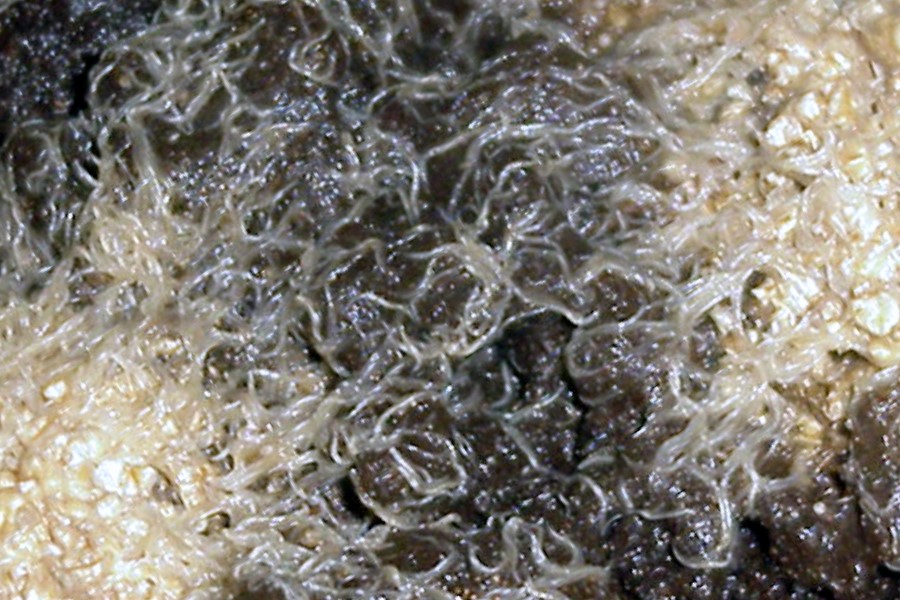
need increases. The worms form
a spider webbing on the underside of the glass and are easily wiped off with a finger and
either rinsed into a beaker of water or feed directly into the tanks. After harvesting
from our collection of containers we rinse the worms from the coconut/peat and oatmeal
using cold water. The worms will sink in a cup of water and by decanting several times you
can separate them from any extraneous matter fairly easily. We then use a plastic eye
dropper with the tip cut a little ( to make the opening a little larger) to feed the
Grindal worms to the fish.
As soon as our fish are able to take Grindal worms, we start them on an every day to third
day cycle. The growth of the little fish seems to explode once they are put into the worm
cycle.
"We grow food not
bait"
|
|